A self-learning putting robot · Research in progress
Second Read: teaching a robot to putt
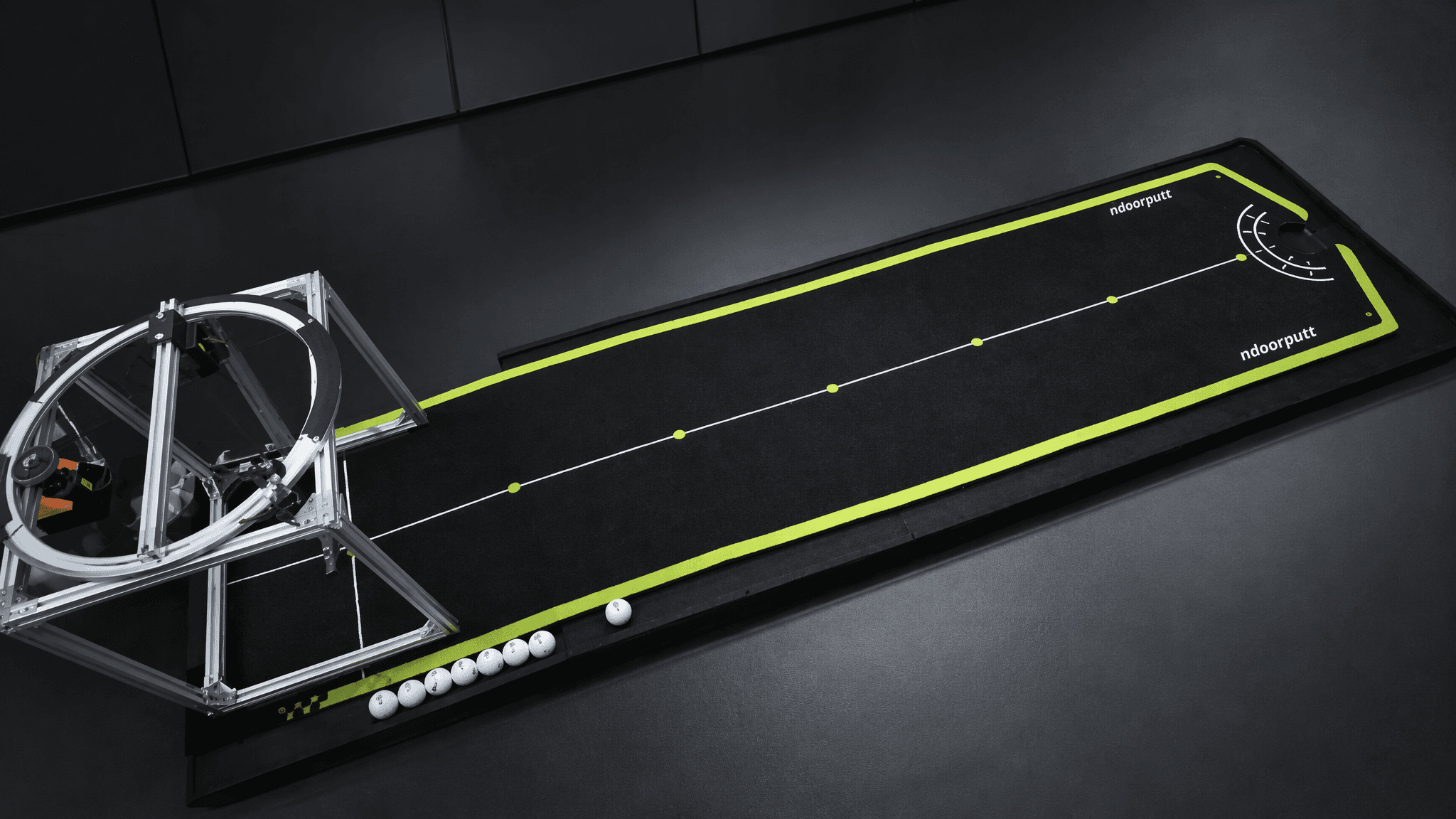
A missed putt gives you a new read. We’re building a robot that can use that same feedback: watch the ball, learn from its roll, and adjust the next attempt.
01 / The question
What can we learn from a miss?
A putt can start on the line you chose and still miss. The slope and the pace both shape its path. A firmer putt spends less time slowing and turning; a softer one has more time to bend.
We call this project Second Read because the first roll gives the robot information for its next attempt. By controlling the stroke and watching the result, we can study the choices golfers make on every green.
Our goal is to understand which combinations of aim and pace leave more room for small mistakes. Here, “learning” means updating the robot’s model from the roll it just observed.
02 / The learning loop
Read. Roll. Learn. Repeat.
First the robot estimates how the putt will behave. Then it compares that idea with what the ball actually does.

Read the surface
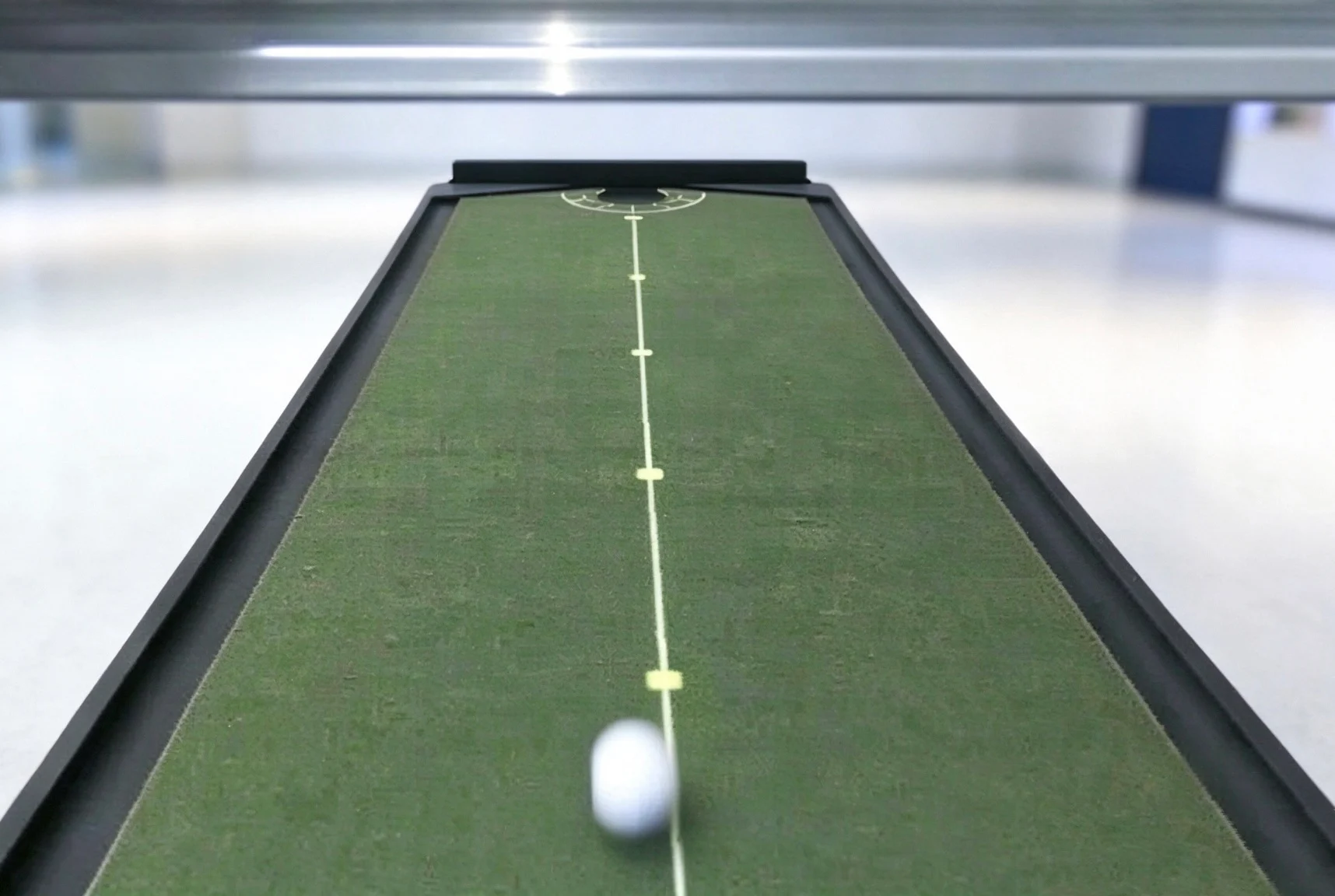
A depth camera builds a map of the putting surface. The robot uses it to estimate where the ground rises, falls, and slopes sideways.
Choose a putt
The robot tries different starting lines and paces in its model. It chooses a combination, then makes the stroke.
Learn from the roll
The camera watches how the ball curves and slows. The robot uses that feedback to update its estimate of how a ball rolls on this surface.
Try again from the same spot
An operator resets the ball. With its updated model, the robot chooses a new line and pace for the next attempt.
03 / What we observed
Same spot. A closer second putt.
In one trial on October 26, 2026, the first ball was last seen short and left of the target. The robot used that roll to update its model, then chose a new line and pace.
The second putt traveled farther and was last seen to the right. Its last observed position was closer to the target.
| First putt | After learning |
|---|---|
| 20.3 cm | 7.6 cm |
Both putts started about 1.56 m (5.1 ft) from the modeled target. The camera record could not confirm a hole-out. This is one trial on one surface setup, not a measure of how often the robot makes a putt.
Two rolls, viewed from above
A closer look at the camera evidence
The camera recorded 46 visible positions on the first roll. The model used 32 to estimate the motion and 14 to check its prediction. Across those 14 checks, the root-mean-square difference from the camera estimates was 4.74 mm. That describes how closely the model replayed the visible roll, not the robot’s putting accuracy.
The camera saw the ball only after launch. Its absolute tracking accuracy and the surface scan’s alignment with gravity were unverified. The scanned heights ranged from −1.1 to +5.2 cm relative to the scan’s reference plane.
Two experimental neural-network steps did not complete successfully: a proposed surface model failed the depth check, and a starting estimate for the motion fit timed out. The system used its baseline methods for both. When replanning, it also relied less on the first putt’s sideways correction for paths farther from that observed roll.
04 / What we want to learn next
A good putt needs room for error.
Can some combinations of line and pace forgive a slightly imperfect stroke?
That is the next question for Second Read. We want to change aim and pace one at a time to see how much each can vary while the ball still has a chance to drop. These are proposed experiments. They are not completed trials; the paths and numbers below are illustrative.
Think of pace as how firmly you hit the putt. For these experiments, we give it a repeatable measure: how far the ball would roll on a level reference surface with no hole. A longer distance means a firmer putt. It is a way to compare settings, not a direct speed measurement.
01 · Hold pace. Vary aim.
How much can your aim vary?
Start from the same spot and use the same pace. Aim a little farther left or right each time to find the outermost lines that still make the putt.
The gap between those lines is the aim window. A wider window would leave more room for a small error in your starting direction. Try another pace and compare.
02 · Hold aim. Vary pace.
How much can your pace vary?
Now keep the start point and aim the same. Hit the ball a little softer or firmer to find the slowest and fastest settings that still make the putt.
That range is the pace window. Repeat with another starting line to explore which line would give you more room for a small error in pace.
One illustrative pace window
Example values onlyEquivalent roll distance on level turf
7.45 ft ± 0.45 ft
In this made-up example, the middle setting is 7.45 ft, with 0.45 ft of room on either side. The numbers describe roll distance, not a speed tolerance or a measure of robot accuracy.
Explore the example and the maths
- Full interval
- ΔL = Lmax − Lmin = 7.9 − 7.0 = 0.90 ft
- Midpoint
- Lmid = (Lmin + Lmax) / 2 = 7.45 ft
- Half-range
- δL = (Lmax − Lmin) / 2 = 0.45 ft
- Relative half-range
- εL = δL / Lmid = (7.9 − 7.0) / (7.9 + 7.0) ≈ 6.04%
- Aim window at a fixed pace
- Δθ(L0) = θmax − θmin
- Pace window at a fixed aim
- ΔL(θ0) = Lmax − Lmin
Here, θ means the starting angle and L means equivalent roll distance. A window is the gap between the lowest and highest settings that would still make the putt. Compare full widths with full widths, or half-ranges with half-ranges.
The next step is to test it. We would need repeated trials from the same spot, on the same surface, with a consistent definition of a made putt. The two-putt trial above does not yet measure these windows.
05 / Try it yourself
Give yourself a second read.
You can use the same idea in a simple practice session.
- Choose your line and pace. Pick a putt that curves. Decide where to start the ball and how firmly to hit it.
- Watch the whole roll. Notice where the ball starts, how it bends, and where it finishes.
- Change one thing. Reset to the same spot. Try a nearby starting line at the same pace, or keep your line and adjust the pace. Compare the result.
A miss is useful feedback. Use the next putt to test what you noticed.
Explore NDoorPutt